Dallas
The Journey CollectionDallas functions as an involuntary way station in Travis McCoy and Russ McCoy’s journey home from Miami to Clarendon. Rather than representing arrival, it marks the distance that remains: their flight reaches the city after midnight, but the two men must spend the night there before they can continue toward Amarillo and then Clarendon. The stop therefore gives the return journey its clearest sense of delay, fatigue, and thwarted expectation.
A Delay Before Home
Dallas enters the journey through travel disruption. At Miami International Airport, Travis McCoy and Russ McCoy learn that Flight 2343 to Dallas has been delayed from its scheduled departure until eleven-thirty. The announcement identifies the immediate obstacle, while Travis’s terse reaction and Russ McCoy’s acknowledgment establish that the delay affects their own flight rather than some distant traveler. Their destination remains home, but the route is already slipping beyond their control.
The delay also sharpens Travis McCoy’s anxiety. Before the announcement, he leans his head against the wall and closes his eyes, attempting to suppress the unease inside him. The airport scene thus frames Dallas not as a chosen stop or meaningful destination but as the next unavoidable stage in an increasingly uncertain passage. The practical mechanics of travel become an emotional rhythm: waiting, receiving bad news, and waiting again.
The Overnight Stop
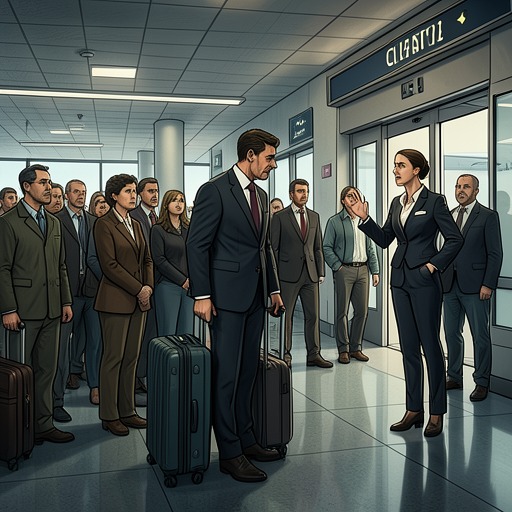
Travis McCoy and Russ McCoy finally stumble off the plane in Dallas just after midnight, already understanding that they will not make a connecting flight to Amarillo. The airline places them on the first available morning flight and provides vouchers for an airport hotel, but these arrangements solve only the immediate problem of shelter. They do not bring the men back to the home they want to reach, leaving Dallas suspended between departure and return.
Their luggage provides one small consolation. It has arrived hours earlier and remains on the turnstile, so they at least have clean clothes for the next stage. The detail gives the delay a concrete, bodily dimension: the men are tired and displaced, but they are not entirely unprepared. Dallas is consequently rendered as a liminal space where ordinary needs are managed while the central need—to get home—remains unmet.
The Failed Connection
At six the next morning, Travis McCoy and Russ McCoy return to Dallas/Fort Worth International Airport to check in for their flight. The schedule appears to offer a clear plan: departure shortly after eight, arrival in Amarillo by nine-thirty, and a return to Clarendon by eleven. That projected sequence briefly restores order to the journey, linking Dallas to the final overland and airborne stages of homecoming.
The plan collapses again when the flight faces another three-hour delay. Dallas therefore repeats the same pattern established at Miami International Airport: a promised departure is followed by postponement, and the men’s hoped-for timetable is replaced by more waiting. The repetition makes the city the journey’s emblem of obstruction rather than progress.
Narrative Significance
Dallas concentrates the contrast between physical movement and emotional arrival. Travis McCoy and Russ McCoy are traveling toward Clarendon, but every delay postpones the reunion and extends the strain of leaving Miami behind. The city is close enough to home to make the goal feel tangible, yet far enough away that the men remain trapped in transit.
For Travis McCoy, the repeated disruption becomes personal as well as logistical. Exhausted after a poor night’s sleep, he complains that even the first flight out cannot leave on time and wonders whether God wants him to get home at all. His frustration reveals the emotional stakes beneath the itinerary: returning to Clarendon is not merely a matter of reaching a geographic destination, but of reclaiming the people and belonging waiting there. Dallas’s narrative role lies in making that return harder, slower, and more urgently desired.